Money & budgeting
No-Buy January 2027: rules, a 31-day plan and a free calendar
December is expensive. Gifts, sales, dinners out and "it's the holidays" purchases pile up, and January's bank balance shows the result. A no-buy January is a simple way to reset: for 31 days you pay for what you need and pause everything else.
This guide gives you clear rules, a week-by-week plan and a free printable calendar with one small action for every day of January 2027.
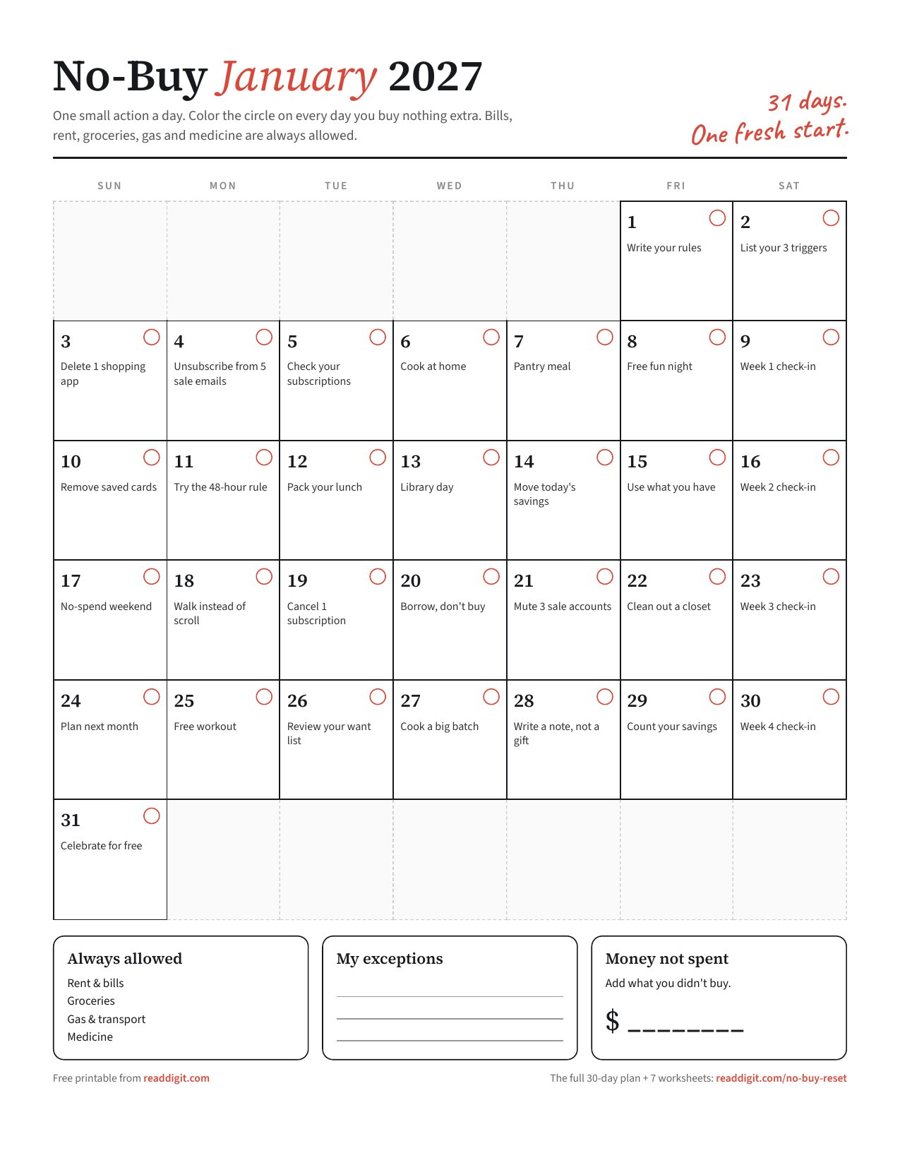
One page, US Letter, ready to print. 31 daily actions, an "always allowed" list and a money-not-spent counter.
Download the free PDF
What is a no-buy January?
A no-buy January is a 31-day challenge where you stop buying anything that isn't essential. Rent, bills, groceries, gas and medicine stay. Takeout, online shopping, new clothes, gadgets and "just because" purchases go on pause.
The goal isn't to suffer for a month. It's to notice where your money really goes, break the habit of buying on autopilot and keep the money you'd normally lose to small purchases.
No-buy or low-buy: pick one
Decide before January 1st, and write it down.
- No-buy: no extra spending at all for 31 days. Best if you want a clean reset.
- Low-buy: a small fun budget for the whole month, for example $50. Best if this is your first challenge or you have kids, events or a birthday in January.
Both work. The best version is the one you'll actually finish.
Example no-buy rules
| Always allowed | Paused for January |
|---|---|
| Rent or mortgage, bills | Takeout and delivery |
| Groceries (from a list) | Online shopping and "add to cart" |
| Gas, transit, car costs | New clothes, shoes, beauty extras |
| Medicine and health | Home decor, gadgets, hobby supplies |
| Replacing something that breaks and you use daily | Coffee runs and snacks out |
Add two or three personal exceptions if you need them, such as one planned dinner with friends or a gift for a January birthday. Exceptions you plan in advance don't break the challenge. Surprise ones do.
Before January 1st: 3 things to do
- Look back 30 days. Go through your bank app and mark every purchase that wasn't a need. Add them up. That number is what the challenge can save you.
- Find your triggers. When do you buy? Late at night, when you're bored, after a hard day, when a sale email arrives? Write down your top three.
- Make buying harder. Delete one shopping app, remove saved cards from your browser and unsubscribe from sale emails. Every extra step gives you time to change your mind.
The 48-hour rule
When you want something during the challenge, don't decide on the spot. Write it on a "want list" with the date and the price, and wait 48 hours. Most of the time the urge passes. If it doesn't, and the item fits your rules, you can buy it calmly instead of on impulse.
Your week-by-week plan
| Week | Focus | Actions |
|---|---|---|
| Jan 1–9 | Set up | Write your rules, list your triggers, delete a shopping app, check subscriptions |
| Jan 10–16 | Build habits | Remove saved cards, use the 48-hour rule, pack lunch, move what you saved |
| Jan 17–23 | Stay strong | A no-spend weekend, cancel one subscription, mute sale accounts |
| Jan 24–31 | Lock it in | Plan February, review your want list, count your savings, celebrate for free |
The free calendar gives you one of these actions for every day, so you never have to wonder what to do next.
Give the money a job, the same day
Money you don't spend tends to disappear unless it goes somewhere. Every time you skip a purchase, move that amount the same day: to a starter emergency fund, to your highest-interest debt or to a goal you care about. Watching that number grow is what keeps you going in week three.
What to do when you slip
Almost everyone slips at least once. One purchase doesn't cancel the month. Use a quick reset:
- Name it: what did you buy, and what triggered it?
- Fix the trigger: delete the app, mute the account, change the routine.
- Continue tomorrow: don't start over and don't quit. Just mark the next day.
After January
Keep the habits that worked: the want list, the 48-hour rule and the apps you deleted. Many people continue with a low-buy February, or one no-spend week every month. The real win isn't one month without shopping. It's knowing you choose what you buy.
Frequently asked questions
What is a no-buy January?
A no-buy January is a 31-day challenge where you stop buying anything that isn't essential. You still pay rent and bills and buy groceries, gas and medicine, but you pause takeout, online shopping, new clothes and other extras.
What is allowed during a no-buy month?
Essentials are always allowed: rent or mortgage, bills, groceries, gas or transport, medicine and anything you already owe. You can also choose a few personal exceptions before you start, as long as you write them down.
What is the difference between a no-buy and a low-buy month?
A no-buy month pauses all extra spending. A low-buy month sets a small fun budget for extras, for example $50 for the month. Low-buy is easier to finish if this is your first challenge.
What if I really need something during the challenge?
Write it on a want list and wait 48 hours. If you still need it after 48 hours and it fits your rules, buy it. If it is a true need, such as a broken item you use every day, replacing it does not break the challenge.
How much money can you save with a no-buy January?
It depends on how much you spend on extras now. Many people find that takeout, online orders, coffee and small impulse buys add up to a few hundred dollars a month. Look at your last 30 days of spending to find your own number.
Related: how to stop living paycheck to paycheck and how much can I spend until payday.