Home / Blog / Allowance by age
Kids & money
How much allowance should I give my kid? A simple guide by age
There is no official "right" allowance. What matters most is that the amount fits your family budget, stays the same every week, and gives your child real choices to make. An allowance is less about the money and more about practice: practice waiting, choosing, saving for something and sometimes making a small mistake while the stakes are low.
Here is a simple way to pick an amount by age, a worked example for a family with three kids, how to split it into Save, Spend and Share, and the questions parents ask most.
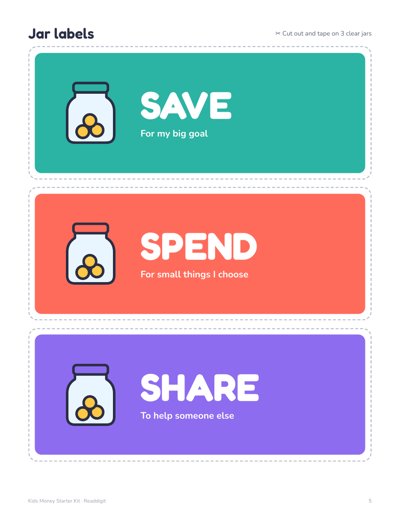
Print, cut and tape them on three jars. The easiest way to start a first allowance this week.
Download the free PDF
The simple rule: $1 per year of age, per week
The most common rule of thumb is $1 per week for each year of your child's age. A 6-year-old gets $6 a week, a 10-year-old gets $10. It's easy to remember, it grows as your child grows, and kids think it's fair because the rule is the same for everyone.
If $1 per year feels like too much for your budget, use 50 cents per year of age instead. The lesson is the same at half the cost. What matters more than the size is that it arrives on the same day every week.
| Age | $0.50 per year | $1 per year | What they can learn |
|---|---|---|---|
| 5–6 | $2.50–$3 | $5–$6 | Coins and bills, need or want |
| 7–8 | $3.50–$4 | $7–$8 | Saving for a small goal |
| 9–10 | $4.50–$5 | $9–$10 | Comparing prices, waiting |
| 11–12 | $5.50–$6 | $11–$12 | Paying for some of their own things |
Example amounts only. Pick what fits your own budget.
Worked example: three kids, ages 6, 9 and 12
Let's say a family uses the $1-per-year rule for three children.
| Child | Weekly | Per year (52 weeks) |
|---|---|---|
| Age 6 | $6 | $312 |
| Age 9 | $9 | $468 |
| Age 12 | $12 | $624 |
| Total | $27 | $1,404 |
$1,404 a year is about $117 a month ($1,404 ÷ 12). That's a real line in a family budget, so add it on purpose. With the half rule ($3, $4.50 and $6), the same family would pay $13.50 a week, or about $58.50 a month.
Tip: allowance doesn't have to be new money. Many parents move money they already spend on small treats, toys and snacks into the allowance, and let the kids decide. The family pays the same, and the kids get the choices.
Split it three ways: Save, Spend, Share
Three clear jars make money visible for young kids. A simple split is 50% Save, 40% Spend, 10% Share.
| Weekly allowance | Save (50%) | Spend (40%) | Share (10%) |
|---|---|---|---|
| $6 | $3.00 | $2.40 | $0.60 |
| $9 | $4.50 | $3.60 | $0.90 |
| $12 | $6.00 | $4.80 | $1.20 |
- Save is for one big goal your child chose, like a toy, a game or a day out.
- Spend is theirs to use on small things, without a lecture.
- Share is for a gift for someone, a classroom drive, or a cause they care about.
Turn saving into a goal they can see
Our 9-year-old wants a $45 building set. Saving $4.50 a week, it takes 10 weeks ($45 ÷ $4.50). If she does one extra paid chore for $1 a week and puts it all in Save, she saves $5.50 a week and reaches the goal in 9 weeks instead (8.2 weeks, rounded up).
Draw the goal as a jar with 10 parts and let her color one part each week. Kids stay motivated when they can see the finish line, and the lesson sticks: extra effort really does get you there faster.
Should allowance be tied to chores?
Parents split on this, and both ways can work. A simple middle road many families like:
- Basic family jobs are unpaid: making the bed, clearing your plate, tidying toys. Everyone helps because they live there.
- The allowance is steady, so kids always have money to practice with.
- Extra jobs can earn extra: washing the car, raking leaves, helping sort the garage.
A chore chart on the fridge makes this easy: kids draw a star for each job, and you add any extra earnings on pay day.
5 rules that make an allowance work
- Same day, same amount. Pick a pay day, like Saturday morning, and stick to it.
- Let them choose. If they spend it all on candy, that's a lesson too. Don't top it up.
- No advances, or only small ones. Borrowing against next week teaches the wrong habit early.
- Talk about prices out loud. At the store, compare two items and ask which one is the better deal.
- Raise it on their birthday. With the per-year rule, the raise happens on its own, and it feels like a big moment.
Practice at home with money games
Younger kids learn faster by playing. Set up a play store with price tags and play money, give them $10, and let them shop. Then count the change together. A "need or want?" sorting game is another easy one: is a warm jacket a need or a want? What about candy?
Frequently asked questions
What age should kids start getting an allowance?
Many families start around age 5 or 6, once a child can count coins and understands that money is traded for things. Start small and simple, with three jars and a weekly pay day.
How much allowance should a 10-year-old get?
With the $1-per-year rule, $10 a week. With the half rule, $5 a week. Choose the amount your budget can keep paying every week without stress.
Should I take away allowance as a punishment?
Most money experts suggest keeping allowance separate from discipline. If the allowance can disappear for unrelated reasons, kids stop seeing it as their money to manage, which is the whole point.
Should allowance be paid in cash or in an app?
For young kids, cash is easier to understand because they can see and count it. Older kids can move to a kids' banking app or a written ledger, as long as they can see their balance.
What should my kid pay for with their allowance?
Start with small treats and toys. As they grow, add a few real items, such as extra snacks at school or birthday gifts for friends, so the allowance teaches real choices.
Related: how to budget for the holidays without debt and how much to save from each paycheck.